Third Eye Chakra: The Seat of Intuition and Inner Wisdom

As we move higher, we reach the Third Eye Chakra, known in Sanskrit as Ajna, meaning “to perceive” or “to command.” Located between the eyebrows, this chakra is the center of intuition, insight, and inner wisdom. It allows us to see beyond the physical world and connect with our deeper knowing.

If the Throat Chakra is about speaking truth, the Third Eye Chakra is about seeing truth—within yourself and beyond illusions. It governs clarity of thought, spiritual awareness, and the ability to trust your intuition.


A Glimpse into the History

The Third Eye has been a symbol of higher consciousness across many ancient traditions. In Hinduism, it represents divine sight, associated with wisdom and enlightenment. In Buddhism, it signifies awakening and the ability to perceive reality beyond illusion. Many cultures have depicted the Third Eye as a portal to inner knowledge and deeper truths.

The Ajna Chakra is represented by a two-petaled lotus and is associated with the color indigo, symbolizing deep perception, wisdom, and imagination. Its element is light, illuminating both the inner and outer worlds.


Signs Your Third Eye Chakra May Be Blocked

When your Third Eye Chakra is blocked or imbalanced, you may struggle with doubt, confusion, or an inability to trust your inner voice. Here are some signs:

Feeling Lost or Directionless: Difficulty making decisions or seeing your life path clearly

Overthinking & Mental Fog: Constant worry, overanalyzing, or lack of focus

Disconnected from Intuition: Doubting yourself or ignoring your gut feelings

Limited Imagination or Creativity: Struggling to visualize possibilities or lacking inspiration

Physical Symptoms: Frequent headaches, eye strain, dizziness, or sinus issues

An overactive Third Eye Chakra may cause paranoia, delusions, or feeling disconnected from reality. Balance is key!


How to Unblock and Balance Your Third Eye Chakra

To strengthen and harmonize your Third Eye Chakra, you must trust your inner wisdom and embrace stillness. Here’s how:

1. Practice Meditation & Visualization: Close your eyes and focus on your inner world. Visualizing a deep indigo light at your Third Eye can enhance clarity and intuition.

2. Listen to Your Inner Voice: Start trusting your gut instincts instead of seeking constant external validation.

3. Engage in Mindfulness: Spend time in nature, journal your thoughts, and observe the world without judgment.

4. Limit External Noise: Reduce distractions like excessive social media or overconsumption of negative news. Clarity comes in stillness.

5. Consume Brain-Nourishing Foods: Eat purple and blue foods like blueberries, grapes, and dark chocolate to support cognitive function.

6. Do Yoga Poses for the Third Eye: Try Child’s Pose (Balasana) and Downward Dog (Adho Mukha Svanasana) to encourage mental clarity.

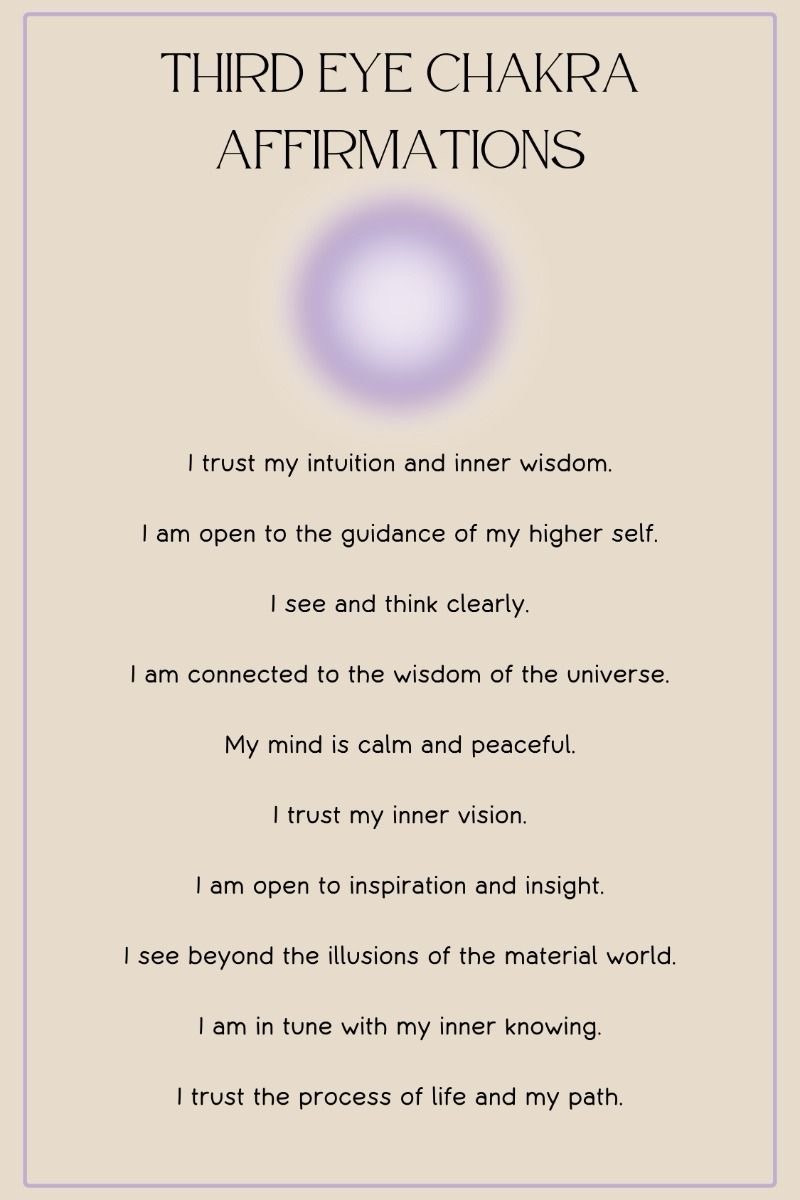
7. Affirmations: Use statements like “I trust my intuition” and “I see clearly beyond illusion.”

8. Explore Dream Work: Pay attention to your dreams—they are often messages from your subconscious.


Final Thought

Your Third Eye Chakra is the key to inner wisdom—it helps you see beyond fear, doubt, and illusion to uncover the truth within.

When balanced, you trust yourself, make decisions with clarity, and feel connected to a deeper understanding of life. The answers you seek are already within you—you just have to learn to listen.

You were meant to see with clarity—I trust in your vision, and let your intuition guide the way.
Throat Chakra: The Power of Truth, Expression, and Authenticity

Moving upward, we arrive at the Throat Chakra, known in Sanskrit as Vishuddha, meaning “pure” or “purification.” This chakra is located at the center of the throat and is the gateway between your heart and mind, governing communication, self-expression, and truth.

If the Heart Chakra is about feeling and receiving love, the Throat Chakra is about speaking that love into existence. It is the center of your voice—your ability to express your thoughts, emotions, and beliefs with clarity and confidence.


A Glimpse into the History

The Throat Chakra has long been recognized in ancient spiritual traditions as the seat of truth. Symbolized by a sixteen-petaled lotus, it is associated with the color blue, representing wisdom, clarity, and depth. Its element is ether (space), which signifies limitless expression and expansion.

In yogic philosophy, Vishuddha is considered the purification center—where we cleanse ourselves of dishonesty, repression, and fear, allowing only truth to remain. Many traditions believe that speaking one’s truth aligns the soul with its highest purpose.


Signs Your Throat Chakra May Be Blocked

When your Throat Chakra is blocked or imbalanced, you may struggle to communicate honestly, fear judgment, or feel unheard. Here are some signs:

Fear of Speaking Up: Holding back opinions, avoiding difficult conversations

Inability to Express Emotions: Struggling to say how you truly feel

Feeling Unheard or Misunderstood: Thinking no one listens to you or values your words

Lying or Hiding Truths: Saying what others want to hear rather than what you truly mean

Creativity Blocks: Feeling uninspired or unable to share your creative work

Physical Signs: Sore throat, thyroid issues, jaw tension, frequent coughing

On the other hand, an overactive Throat Chakra may result in talking excessively, interrupting, gossiping, or dominating conversations. Balance is key!


How to Unblock and Balance Your Throat Chakra

To restore harmony to your Throat Chakra, you must embrace your authentic voice and allow truth to flow freely. Here’s how:

1. Speak Your Truth: Practice honest, open communication—whether in conversations, journaling, or self-reflection.

2. Sing or Chant: Vibrations help clear energetic blockages—try humming, chanting “HAM” (the Throat Chakra mantra), or simply singing along to your favorite songs.

3. Throat-Opening Yoga Poses: Try Fish Pose (Matsyasana), Shoulder Stand (Sarvangasana), and Lion’s Breath (Simhasana) to release tension in the throat.

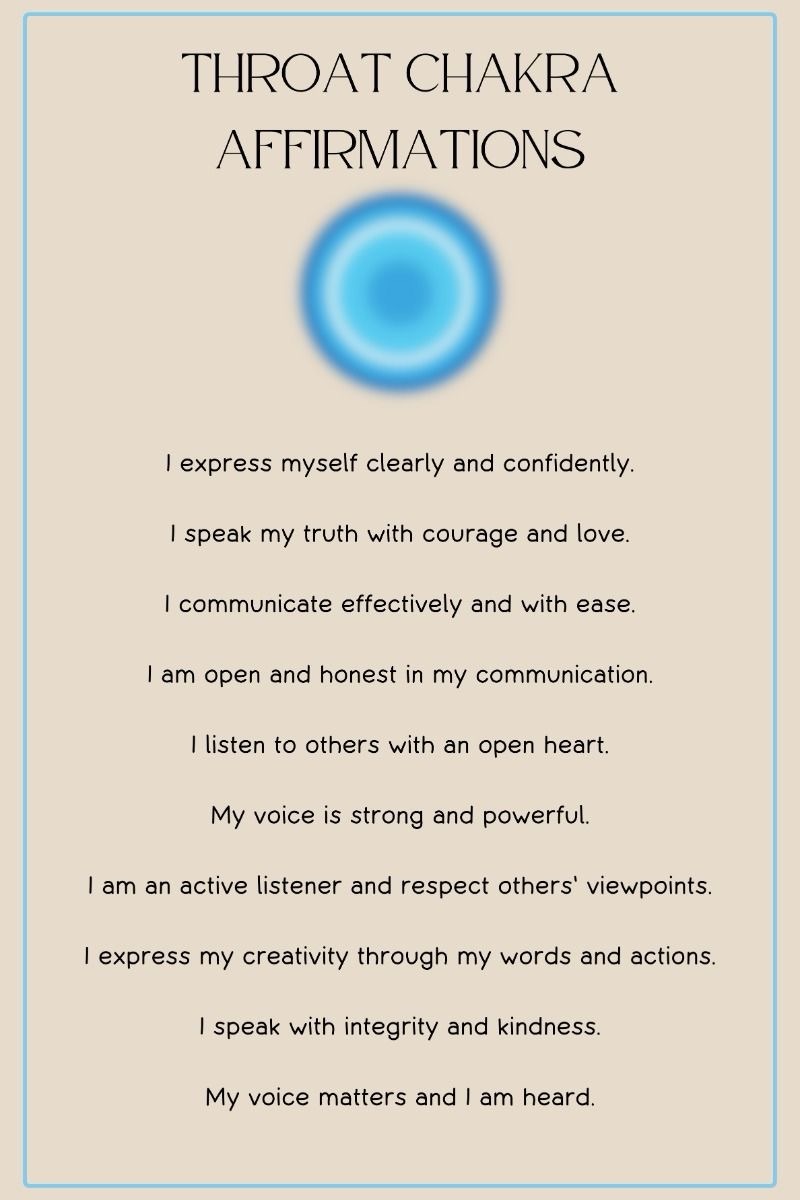
4. Affirmations: Use statements like “My voice is powerful,” or “I speak with confidence and clarity.”

5. Hydrate & Nourish: Drink plenty of water and consume soothing blue foods like blueberries, herbal teas, and raw honey.

6. Write or Create Freely: Express yourself through writing, poetry, painting, or music—let your truth take form.

7. Listen to Yourself & Others: Practice mindful speaking and active listening. A balanced Throat Chakra allows both self-expression and the ability to truly hear others.


The Gift of the Throat Chakra

Your Throat Chakra is more than just a center for speech—it is a bridge between your thoughts and the world, between your heart and your expression. When balanced, it allows you to speak with clarity, share your creativity, and stand confidently in your truth.

Too often, we silence ourselves—out of fear, doubt, or the belief that our voice doesn’t matter. But the gift of the Throat Chakra is the ability to express who you truly are, without apology.

When your Throat Chakra is open, you:

Speak with confidence and honesty—not just what others want to hear, but what you truly feel.

Express your creativity freely—through writing, singing, storytelling, or any form of self-expression.

Set boundaries with clarity—saying “no” when needed and standing up for yourself without guilt.

Listen deeply—not just hearing others, but understanding them with an open heart.

Align with your purpose—your words reflect your truth, guiding you toward what is meant for you.

The Throat Chakra reminds you that your voice holds power—it can heal, inspire, and shape the world around you.

So speak your truth. Sing your song. Write your story. Let your voice be heard.

Heart Chakra: The Power of Love, Connection, and Healing

As we move upward through the chakras, we arrive at the Heart Chakra, known in Sanskrit as Anahata, meaning “unstruck” or “unhurt.”

Located at the center of the chest, this chakra is the bridge between the lower (physical) and upper (spiritual) chakras. It governs love, compassion, forgiveness, and emotional balance—not just in relationships with others, but also in how you love and accept yourself.

If the Solar Plexus Chakra is your fire, the Heart Chakra is your breath—it expands and contracts, giving and receiving, connecting you to the world with warmth, empathy, and truth.


A Glimpse into the History

The Heart Chakra has been recognized in ancient yogic and spiritual traditions for centuries. It is symbolized by a twelve-petaled lotus and is associated with the color green, representing renewal, harmony, and growth. Its element is air, symbolizing openness, freedom, and movement.

Many traditions, from Buddhism to Sufism, emphasize the heart as the seat of the soul, the place where divine love flows.

In yogic philosophy, it is where duality dissolves into unity, allowing us to see ourselves and others through the eyes of compassion rather than fear.


Signs Your Heart Chakra May Be Blocked

A blocked Heart Chakra can manifest as difficulty in giving or receiving love, emotional detachment, or deep-seated resentment. Here are some signs of imbalance:

Difficulty Trusting Others: Fear of vulnerability, emotional walls, or pushing people away

Holding Onto Past Hurts: Struggling with forgiveness or carrying emotional wounds

Loneliness or Isolation: Feeling disconnected from loved ones or avoiding relationships

Self-Criticism: Being hard on yourself, struggling with self-love or self-worth

Physical Signs: Heart-related issues, lung problems, poor circulation, or tension in the chest

When this chakra is closed, it can make love feel like a risk rather than a gift. On the other hand, an overactive Heart Chakra may lead to overgiving, people-pleasing, or losing yourself in relationships.


How to Unblock and Balance Your Heart Chakra

To bring harmony to the Heart Chakra, you must release past pain, open yourself to love, and allow yourself to both give and receive without fear. Here’s how:

1. Practice Self-Love: Speak kindly to yourself, engage in self-care, and honor your needs.

2. Heart-Opening Yoga: Try poses like Camel Pose (Ustrasana), Cobra Pose (Bhujangasana), and Bridge Pose (Setu Bandhasana) to expand your chest.

3. Affirmations: Use statements like “I am open to love,” or “I give and receive love freely.”

4. Forgiveness Work: Release grudges, whether toward yourself or others, to lighten your heart.

5. Breathe Deeply: Practice pranayama (breathwork) like Anulom Vilom (Alternate Nostril Breathing) to bring balance to your emotions.

6. Connect with Nature: Spend time outside, especially in green spaces, to absorb the healing energy of the Heart Chakra.

7. Wear or Surround Yourself with Green: Green represents renewal and heart-centered energy—bring it into your life through clothing, decor, or even food like spinach, avocados, and green tea.


Final Thought

Your Heart Chakra is where true connection begins—with yourself, with others, and with the world. Love is not just an emotion; it is a force, a healer, and the very essence of life itself.

When you live with an open heart, you allow love to flow freely—without fear, without resistance. You learn that love is not something you must chase; it is something you are.

You were meant to love boldly—keep your heart open, and let love move through you.

Solar Plexus Chakra: Igniting Your Inner Power and Confidence

After flowing through the creative and emotional energy of the Sacral Chakra, we rise to the Solar Plexus Chakra, known in Sanskrit as Manipura, meaning “lustrous gem.” Located in the upper abdomen, just above the navel, this chakra is the center of personal power, confidence, and self-discipline.

If the Root Chakra is your foundation and the Sacral Chakra is your flow, the Solar Plexus Chakra is your fire—the source of your motivation, willpower, and sense of self.

It’s where you develop the strength to take action, set boundaries, and move toward your goals with conviction.


A Glimpse into the History

The Solar Plexus Chakra has its roots in ancient Indian traditions, mentioned in early yogic and tantric texts. It is symbolized by a ten-petaled lotus and associated with the color yellow, representing warmth, energy, and enlightenment. Its element is fire, symbolizing transformation, strength, and the power to create change.

In many spiritual traditions, fire is seen as a purifier—burning away doubt and fear to reveal true strength.

This is the essence of the Solar Plexus Chakra: stepping into your personal power with clarity and purpose.


Signs Your Solar Plexus Chakra May Be Blocked

When this chakra is out of balance, you might struggle with self-doubt, lack of motivation, or difficulty asserting yourself. Some common signs include:

Low Self-Esteem: Feeling insecure, unworthy, or overly self-critical

Lack of Motivation: Procrastination, indecisiveness, or feeling stuck

Fear of Judgment: Worrying too much about what others think

Control Issues: Either feeling powerless or trying to control everything

Digestive Problems: Stomach aches, bloating, ulcers, or issues related to the gut

A blocked Solar Plexus Chakra can make you feel powerless, lost, or unsure of yourself, while an overactive one can lead to arrogance, stubbornness, or the need to dominate situations.


How to Unblock and Balance Your Solar Plexus Chakra

Restoring balance to the Solar Plexus Chakra is about reigniting your inner fire and reclaiming your confidence. Here’s how:

1. Power Poses & Movement: Engage in physical activity like yoga (especially core-strengthening poses like Boat Pose (Navasana) or Warrior Poses) to activate this energy center.

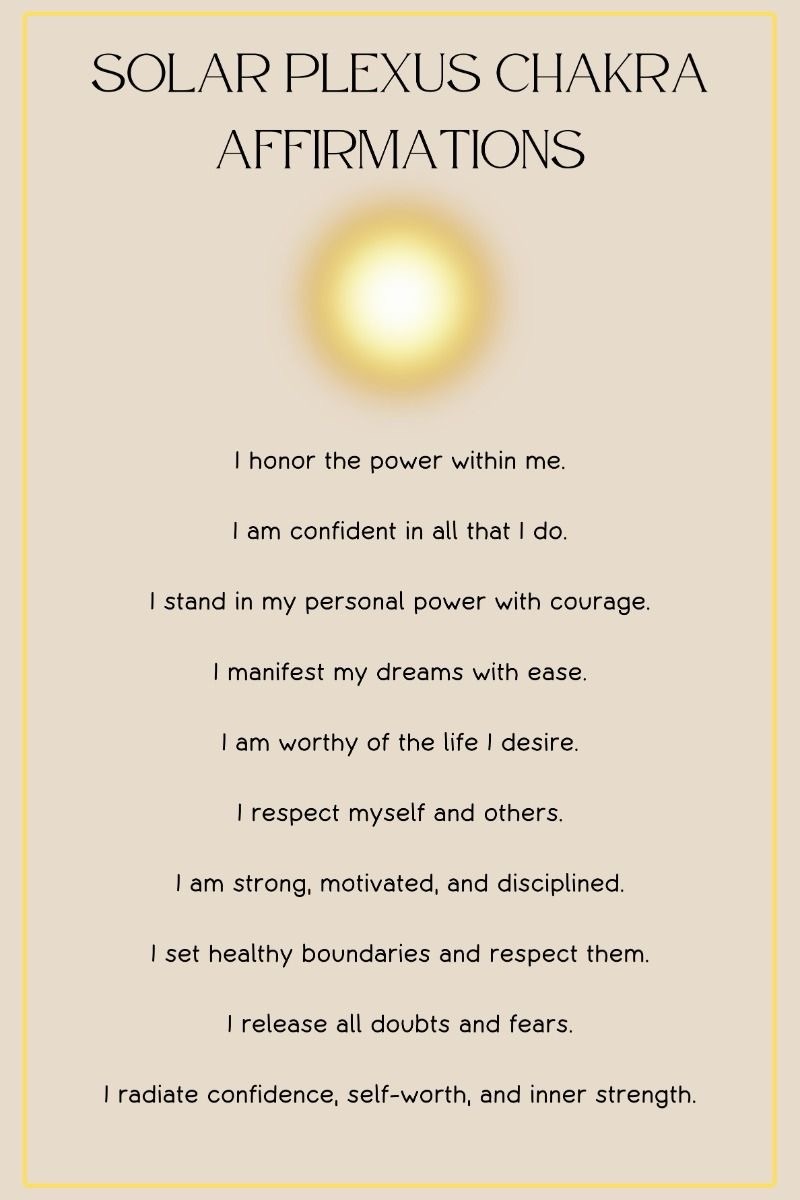
2. Affirmations: Use statements like “I am strong and capable,” or “I trust myself and my decisions.”

3. Connect with Fire: Spend time in sunlight, light candles, or visualize a bright, golden flame in your core growing stronger with each breath.

4. Set Small Goals: Accomplishing even small tasks builds confidence and strengthens this chakra.

5. Eat Yellow Foods: Bananas, lemons, corn, and turmeric can support Solar Plexus energy.

6. Breathwork: Practice deep breathing exercises, especially Kapalabhati (Breath of Fire) to stimulate energy and focus.


The Gift of the Solar Plexus Chakra

When your Solar Plexus Chakra is balanced, you feel confident, driven, and aligned with your purpose. You trust yourself and make decisions from a place of strength rather than fear.

This chakra reminds you that you are capable, you are powerful, and you are in control of your own story.

You weren’t meant to shrink yourself to fit the world—You were meant to lead with courage. Keep your faith strong, even when the path is uncertain.

Money Isn’t Lost; It’s Transferred Into *Abundance*

We often look at money through the lens of subtraction. You swipe your card, hand over cash, and—poof—it’s gone.

There’s an almost automatic reaction of stress or scarcity, especially when the numbers in your bank account shrink.

But what if we shifted that mindset? What if, instead of seeing money as something that’s lost, we saw it as something that’s transferred into abundance?

When you spend $200 on groceries, it’s easy to focus on the dent it made in your budget. But pause for a moment. What did you receive in return? You didn’t just “lose” $200—you exchanged it for shelves stocked with food to nourish your family. You gained the convenience of not having to hunt, gather, or grow that food yourself. You have fresh produce, snacks for your kids, meals that will bring your family together around the table. That’s not a loss. That’s abundance.

Think about your morning coffee. Maybe you spend $5 at your favorite café. It’s not just coffee—it’s a warm ritual that starts your day, crafted by someone else so you didn’t have to grind the beans, boil the water, and perfect the brew. That small purchase buys comfort, convenience, and a little moment of joy.

Money is always an exchange. It’s never just disappearing into the void. It’s flowing—transforming into goods, services, experiences, and opportunities. The key is to recognize what it’s transforming into.

When we approach spending with gratitude for what we receive, the stress tied to money begins to loosen. Instead of thinking, “I had $200, and now I don’t,” we can think, “I’ve exchanged $200 for nourishment, convenience, and the ability to provide for my family.”

This mindset shift doesn’t ignore the importance of budgeting or financial responsibility. It simply reframes how we view the natural flow of money in and out of our lives.

By seeing spending as an investment in abundance—whether it’s food, shelter, education, or small joys—we soften the grip of scarcity thinking.

Now, just to be clear—I’m not saying,

“Okay, go wild and buy everything your heart desires!” — (“Put the online shopping cart down…don’t say YES to everything in your amazon “save for later” list.)

I’m simply offering a new way to look at your money—a way to encourage a healthier, more abundant relationship with it. One where spending isn’t just a loss, but a conscious exchange that brings value into your life.

So the next time you feel that sting of spending, ask yourself:

What abundance did I just receive in return?

This shift of mindset will also allow you to see how many blessings truly surround you.

The Sacral Chakra: Embracing Flow, Creativity, and Emotional Freedom

After grounding ourselves with the stability of the Root Chakra, we move upward to the Sacral Chakra, known in Sanskrit as Svadhisthana, which means “one’s own dwelling place.”

Located just below the navel, this chakra is the center of our creativity, emotions, sensuality, and pleasure. It’s where we begin to experience life beyond survival—where we tap into the flow of feelings, connections, and self-expression.

If the Root Chakra is the foundation, the Sacral Chakra is the river that flows from it, carrying the vibrant currents of our passions, desires, and emotional experiences.


A Glimpse into the History

The concept of the Sacral Chakra comes from ancient Indian spiritual traditions, first mentioned in the Vedas and later detailed in texts like the Upanishads. It’s symbolized by a six-petaled lotus flower and is associated with the color orange, representing warmth, vitality, and creativity. The element connected to this chakra is water, reflecting its qualities of flow, adaptability, and emotional depth.


Signs Your Sacral Chakra May Be Blocked

When the Sacral Chakra is out of balance, you might feel emotionally stuck or disconnected from your creativity and sense of joy. Here are some signs to look for:

Emotional Imbalance: Mood swings, feeling overwhelmed, or emotionally numb

Creative Blocks: Struggling to express yourself or feeling uninspired

Relationship Issues: Difficulty forming or maintaining healthy, intimate connections

Guilt and Shame: Holding onto past regrets or feeling unworthy of pleasure

Physical Symptoms: Lower back pain, hip issues, reproductive problems, or bladder issues

A blocked Sacral Chakra can make life feel rigid, as if the natural flow of emotions and creativity has been dammed up.


How to Unblock and Balance Your Sacral Chakra

Restoring balance to the Sacral Chakra is all about reconnecting with your emotions, creativity, and body. Here are some ways to nurture this energy center:

1. Embrace Creativity: Paint, write, dance, cook—anything that allows you to express yourself without judgment.

2. Move Your Body: Gentle hip-opening stretches, yoga poses like Goddess Pose (Utkata Konasana) or Pigeon Pose (Eka Pada Rajakapotasana) help release tension.

3. Connect with Water: Spend time near water, take relaxing baths, or even visualize a flowing river to help restore emotional flow.

4. Affirmations: Repeat affirmations like, “I allow myself to feel deeply,” or “I am creative, passionate, and full of joy.”

5. Honor Your Emotions: Give yourself permission to feel without labeling emotions as “good” or “bad.” They’re all part of the human experience.

6. Sensory Experiences: Engage your senses—light candles, listen to music, savor delicious food, and surround yourself with colors that inspire warmth and joy.


The Gift of the Sacral Chakra

When your Sacral Chakra is balanced, you feel alive, inspired, and emotionally connected—to yourself, to others, and to the world around you. You flow with life’s ups and downs, embracing both the joys and the lessons with openness.

Remember, your emotions and creativity are not something to suppress or fear—they’re the very essence of what makes you uniquely you. Let yourself feel, create, and flow.

Your spirit wasn’t meant to stay still; it was meant to flow with purpose.

Root Chakra: Finding Your Ground in a Shifting World

At the very base of your spine, there’s an invisible yet powerful energy center known as the Root Chakra—or in Sanskrit, Muladhara, which translates to “root support.” Just like the roots of a tree anchor it firmly into the earth, your Root Chakra is the foundation that keeps you feeling safe, stable, and grounded in the world.

Understanding the Root Chakra isn’t just about energy; it’s about connecting to the most basic parts of being human—our need for security, belonging, and survival.


A Glimpse Into Its History

The concept of chakras comes from ancient Indian traditions, first mentioned in the Vedas over 2,000 years ago. In these teachings, chakras are seen as spinning wheels of energy that influence our physical, emotional, and spiritual well-being.

The Root Chakra is considered the first chakra, located at the base of the spine near the tailbone. Its energy is associated with the earth element, symbolizing grounding and connection to the physical world. Its color is red, representing life force, strength, and vitality.


What Does the Root Chakra Influence?

When your Root Chakra is balanced, you feel:

Grounded: Like you have your feet firmly planted, even when life gets chaotic.

Secure: Emotionally and physically safe in your environment.

Confident: Trusting yourself to meet your basic needs and navigate challenges.

Present: Fully engaged in the moment without overwhelming fear or anxiety.


Signs Your Root Chakra Might Be Blocked

A blocked or imbalanced Root Chakra can manifest in both emotional and physical ways:

Emotional Signs:

Chronic anxiety or fear: Feeling like you’re always on edge or in survival mode.

Insecurity: Struggling with self-doubt or fear of failure.

Disconnection: Feeling “floaty,” restless, or like you don’t belong anywhere.

Obsessive need for control: Holding on tightly to routines or resisting change.

Physical Signs:

• Lower back pain

• Leg, foot, or hip issues

• Digestive problems

• Fatigue or feeling drained even after rest

Think of it like a house: if the foundation is cracked, the whole structure feels unstable. The Root Chakra is your energetic foundation.


What Causes a Blocked Root Chakra?

• Unstable environments growing up (financial struggles, family conflict)

• Major life changes (moving, job loss, relationship breakups)

• Trauma or fear-based experiences

• Neglecting basic self-care—like poor sleep, bad nutrition, or lack of routine


How to Unblock and Balance the Root Chakra

1. Ground Yourself in Nature

• Walk barefoot on grass, sand, or soil (“earthing” helps connect you to the earth’s energy).

• Spend time outside, even if it’s just sitting under a tree or feeling the sun on your skin.

2. Move Your Body Intentionally

• Yoga poses like Mountain Pose, Warrior I & II, and Tree Pose.

• Simple stretches focusing on the legs, hips, and lower back.

• Dancing, walking, or any movement that makes you feel present in your body.

3. Practice Mindful Breathing

• Root Chakra affirmation: As you breathe deeply, repeat silently or out loud:

“I am safe. I am grounded. I belong here.”

• Imagine a warm, red light glowing at the base of your spine, growing stronger with each breath.

4. Create a Sense of Stability

• Establish daily routines, even simple ones like morning stretches or evening tea.

• Declutter your living space to create an environment that feels safe and organized.

5. Nourish Your Body with “Earthy” Foods

• Root vegetables (carrots, beets, potatoes)

• Protein-rich foods (lentils, beans, nuts)

• Red-colored fruits (strawberries, apples, pomegranates)

6. Journaling Prompts for Reflection:

When do I feel the most secure and grounded?

What areas of my life feel unstable, and how can I create more balance?

What does “home” feel like to me?


A Final Thought:

Balancing your Root Chakra isn’t about achieving perfection—it’s about creating a strong foundation so you can weather life’s ups and downs without losing your sense of self.

When you nurture this energy, you’ll find that you feel more present, more connected, and more at peace, even when the world around you shifts.

Introduction to the Chakras: *The Energy Within*

Have you ever felt out of balance without knowing exactly why?

Maybe you’ve experienced emotional blocks, physical tension, or a sense of disconnection from yourself.

This is where the concept of chakras comes in—a powerful framework for understanding the flow of energy within us.

The word chakra comes from Sanskrit, meaning “wheel” or “disk,” symbolizing spinning centers of energy in the body.

These energy centers are not just abstract concepts; they’re deeply connected to our physical health, emotional well-being, and spiritual growth.

When our chakras are balanced, we feel vibrant, grounded, and aligned. When they’re blocked or overactive, we may experience emotional struggles, physical discomfort, or a sense of being “stuck.”

There are seven main chakras, each associated with specific areas of the body and aspects of our lives:


1. Root Chakra (Muladhara) – “I Am”

Location: Base of the spine

Color: Red

Element: Earth

Significance: Grounding, stability, security, and survival needs

Balanced: You feel secure, safe, and connected to the present moment.

Blocked/-Imbalanced: Fear, insecurity, or feeling ungrounded.


2. Sacral Chakra (Svadhisthana) – “I Feel”

• Location: Lower abdomen, just below the navel

Color: Orange

Element: Water

Significance: Creativity, emotions, pleasure, and relationships

Balanced: You feel creative, emotionally balanced, and open to joy.

Blocked/Imbalanced: Emotional instability, guilt, or difficulty expressing desires.


3. Solar Plexus Chakra (Manipura) – “I Do”

Location: Upper abdomen, near the diaphragm

Color: Yellow

Element: Fire

Significance: Confidence, personal power, motivation, and self-discipline

Balanced: You feel confident, strong, and in control of your life.

Blocked/Imbalanced: Low self-esteem, lack of direction, or anger issues.


4. Heart Chakra (Anahata) – “I Love”

Location: Center of the chest

Color: Green (sometimes pink)

Element: Air

Significance: Love, compassion, relationships, and emotional healing

Balanced: You feel open, loving, and connected to others.

Blocked/Imbalanced: Jealousy, fear of intimacy, or emotional detachment.


5. Throat Chakra (Vishuddha) – “I Speak”

Location: Throat

Color: Blue

Element: Ether (Space)

Significance: Communication, self-expression, and truth

Balanced: You express yourself clearly and authentically.

Blocked/Imbalanced: Fear of speaking up, dishonesty, or throat-related health issues.


6. Third Eye Chakra (Ajna) – “I See”

Location: Between the eyebrows (forehead)

Color: Indigo

Element: Light

Significance: Intuition, perception, wisdom, and inner vision

Balanced: You trust your intuition and have a clear sense of purpose.

Blocked/Imbalanced: Confusion, lack of insight, or difficulty making decisions.


7. Crown Chakra (Sahasrara) – “I Understand”

Location: Top of the head

Color: Violet or White

Element: Cosmic Energy

Significance: Spiritual connection, enlightenment, and higher consciousness

Balanced: You feel deeply connected to the universe and your higher self.

Blocked/Imbalanced: Feeling disconnected, lack of purpose, or spiritual doubt.


Understanding the chakras isn’t about perfection—it’s about awareness. It’s about tuning in, noticing where your energy feels blocked or imbalanced, and gently bringing yourself back into alignment.

In the posts to follow, I’ll break down each chakra, exploring its significance, signs of imbalance, and simple practices to help you feel more connected, both within yourself and with the world around you.

Your energy tells a story. Let’s start listening.

It’s OKAY To Feel *PRETTY* And To Say it OUT LOUD

It’s not just okay—it’s important to feel pretty, beautiful, or confident in your own way. Feeling pretty isn’t about vanity; it’s about self-expression, self-care, and self-love.

Sometimes, especially as a mother or someone focused on caring for others, it’s easy to feel like putting energy into your appearance is “unnecessary” or even “selfish.” But it’s not! When you feel good about yourself—inside and out—it radiates into everything you do.

Feeling pretty can mean different things to different people. It could be:

• Wearing an outfit that makes you feel confident

• Taking care of your skin, hair, or posture

• Smiling and embracing your natural beauty

• Feeling strong and healthy in your body

• Expressing yourself through creativity, like makeup or fashion

• Simply recognizing your inner beauty and allowing it to shine

The other day, I took a selfie because, in that moment, I did feel pretty. But when it came time to post it, I hesitated. I started doubting myself, thinking, “What if someone sees this and thinks, ‘She’s not pretty’”.

But then I stopped and asked myself—Why am I so afraid to own this feeling? Why do we, as women, so often hesitate to celebrate ourselves?

So I decided to change the narrative. Instead of letting doubt win, I posted the selfie with the simple caption: “feeling pretty”. And that moment was freeing. Because feeling good about yourself is not something you have to hide. It’s something you can embrace, celebrate, and share—at any age, in any season of life.

I want other women and girls to know that it’s okay to feel good about yourself and to actually say it out loud. You don’t need permission to shine. You don’t need validation to embrace your beauty.

So if you feel pretty today, own it. Take the picture, wear the outfit, smile in the mirror, and don’t be afraid to share your light with the world. Because confidence isn’t about being perfect—it’s about being unapologetically yourself.

Be True To Your *ESSENCE*

There is something within you that is completely unique, something that cannot be replicated, replaced, or erased. It’s not just your personality, your talents, or the roles you play in life—it’s something deeper. It’s your essence.

Your essence is the energy you bring into the world, the way you see things, the quiet knowing in your soul that whispers who you truly are. It’s not something you have to create—it’s something you already are. But in a world that constantly tells us who we should be, it’s easy to drift away from it.

The Layers That Cover You

From the moment we’re born, we absorb expectations. We learn to behave in ways that make others comfortable. We mold ourselves to fit in, to be accepted, to avoid rejection. Over time, layers build up—layers of what we think we should be.

• The layer of people-pleasing, where we silence our own needs to keep the peace.

• The layer of comparison, where we measure ourselves against others and feel like we come up short.

• The layer of self-doubt, where we hesitate to step into who we truly are.

But your essence is still there, waiting beneath it all. The real question is—are you listening to it?

Recognizing Your Essence

Being true to your essence doesn’t mean you have to be the loudest voice in the room. It doesn’t mean you have to change who you are—it means returning to who you’ve always been.

Ask yourself:

When do I feel most alive?

What makes me lose track of time?

When do I feel like myself, without trying?

Your essence shines when you are in flow—whether that’s through creativity, deep conversations, being in nature, teaching, writing, moving your body, or simply being present.

Letting Go of What Isn’t Yours

To be true to your essence, you have to let go of the things that aren’t truly you. Not the parts of you that change and evolve, but the ones that were never yours to carry.

Let go of the need to be understood by everyone—your essence is not for approval, it’s for expression.

Let go of who you thought you had to be—growth is natural, but forcing yourself into a mold is not.

Let go of the fear of shining—playing small doesn’t serve your soul.

Living in Alignment

Once you start honoring your essence, things begin to feel lighter. You no longer exhaust yourself trying to fit into a version of yourself that wasn’t meant for you. Instead, you:

Speak with authenticity instead of saying what’s expected.

Make choices that resonate instead of following a script.

Surround yourself with people who see the real you instead of who they want you to be.

And the beautiful thing? The more you embrace your true essence, the more you inspire others to do the same.

You Are Here for a Reason

The world doesn’t need another copy. It doesn’t need you to shrink, shift, or shape yourself to fit someone else’s version of you. It needs you as you are.

So today, take a deep breath. Feel the weight of expectations fall away. And remember—being true to your essence is not something you have to earn. It’s something you simply have to allow.

Be you. Unapologetically. Completely. Fully. The world is better for it.