Soften The Heart #33 : Children Are a Gift — Even When Our Childhood Didn’t Feel Like One

“Children are a gift from the Lord; they are a reward from Him.”

Psalm 127:3

Children are one of the clearest pictures of God’s heart. Their curiosity, honesty, wonder, and purity remind us of what truly matters. Scripture tells us that children are a gift — not because of what they do, but because of who they are: reflections of God’s creativity and love.

As parents, this verse reminds us to slow down and cherish our kids, to remember that they’re not burdens or interruptions but blessings entrusted to us. They bring joy, purpose, and a fresh view of the world.

But for many adults, this verse can stir something deeper.

Not everyone grew up feeling protected, valued, or cherished. Some people carry wounds from a childhood where they were mistreated, overlooked, or harmed. And hearing “children are a gift” can feel confusing — even painful.

So if that’s you, here’s something important to know:

**God’s intention for children was always good.

Your pain was never His plan.**

When the Bible calls children a gift, it is describing how God sees them — not how every human treats them. Some adults act out of their own brokenness, and their choices leave deep marks on innocent hearts. But your mistreatment was never a reflection of your worth. You were always precious. You were always a gift. Someone else simply failed to honor what God created.

And God grieves with you.

He is “close to the brokenhearted” (Psalm 34:18) and fiercely protective of the vulnerable. Jesus Himself said it would be better for a person to be thrown into the sea than to harm a child (Matthew 18:6). That means He saw you. He cared. He never agreed with what was done to you.

The good news?

God restores what was wounded.

He heals the childhood parts of us that were hurt, silenced, or forgotten. And He gently rebuilds what was broken — identity, trust, safety, and hope.

So whether you grew up cherished or neglected, this verse has a message for you:

Cherish the children in your life today — including the child you once were.

Let today be a reminder to love your kids with intention and tenderness…

but also to let God love and restore the parts of you that didn’t receive that same tenderness growing up.

Children are a gift.

And that includes you — the child you used to be, and the person you are becoming.
Soften The Heart: Devotional #32 — He Will Never Leave You

“Be strong and courageous. Do not be afraid or terrified… for the Lord your God goes with you; He will never leave you nor forsake you.”

Deuteronomy 31:6

I feel like at a very young age, I always leaned into God. Even when life didn’t make sense, I somehow knew I was loved. Not just loved by people—but by God. It was a quiet knowing that I was held, seen, and cared for, even in moments where nothing around me felt steady.

But as I got older and life began to unfold in more complicated ways, abandonment became a deep and painful thread in my story. The kind of wound that doesn’t leave a scar you can see, but one you carry in your heart.

I experienced the “primal wound” of being separated from my biological parents. My parents divorced when I was eight, and I think most of us kids felt like second picks to their new spouses. Then, when I was seventeen—my senior year of high school—my mom moved out of our home to follow her husband’s job transfer. She wanted me to come, but I didn’t. I couldn’t. It felt like she chose him over me, and the message I internalized was: You’re not worth staying for.

I moved in with my dad and stepmom. And then, after high school, my dad—“in the nicest way”—told me it was time to move out. He helped me get set up with school and paid for my apartment, which I’m thankful for. But the emotional part of it still hurt. Deeply.

As I became a mother myself, I found that old wounds resurfaced in new ways. I couldn’t understand how some of the choices my parents made were even possible once I knew the depth of love I had for my own kids.

These layered experiences of being left or feeling replaceable shaped my thoughts in relationships. When someone got close, I would think, It’s just a matter of time before they leave… or choose someone over me.

But even in all that pain—even when I questioned people—I kept leaning on God. I kept coming back to His promises. His love. His Word.

Deuteronomy 31:6 says He will never leave you nor forsake you. And I believe that. It’s the one relationship in my life that has never felt conditional. I trust God in a way I struggle to trust others, because He has never walked away. He has never picked someone else over me. He doesn’t move on or get tired or lose interest.

So I return to Him. Again and again. Not because I’m perfect—but because I know He is.

If you’ve ever felt left behind, replaced, or like you had to earn your place in someone’s life… please know this:

God doesn’t leave. He walks with you through every ache, every misunderstanding, every broken piece. And He whispers, “You are mine. You are loved. I will never let go.”

When Our Child’s Tears Mirror Our Own: Breaking the Cycle of Emotional Projection

“Until you make the unconscious conscious, it will direct your life and you will call it fate.”

Carl Jung

Why do we sometimes get triggered by our children’s emotions?

One word: Projection.

It sounds simple, but it’s layered and deeply human. Projection means we unconsciously place our own unresolved feelings onto others—often without realizing it. And with parenting, this tends to show up when our kids express emotions we weren’t allowed to feel growing up.


When Their Emotions Stir Something In Us

Let’s say your child starts crying over something that seems small—maybe they can’t get their shoes on. You feel irritation rise. You say, “You’re fine. Stop crying. It’s not a big deal.”

But under that reaction might be this:

You weren’t allowed to cry when you were small. You were told to toughen up. Crying meant weakness. And now, when your child does what you weren’t permitted to do, it brings up old pain you never had space to process.

What you’re feeling isn’t just about their emotion—it’s about your history with that emotion.

How Do We Break the Cycle?

1. Pause Before Reacting

Even a brief pause creates space. In that moment, silently ask yourself:

“What am I feeling right now?” “Is this about them… or something unresolved in me?”

This small habit can change everything.

2. Get Curious Instead of Controlling

Shift from, “This needs to stop,” to, “What are they trying to express?”

Emotions are messages. Our children are not giving us a hard time—they’re having a hard time.

3. Reflect on Your Own Story

Later, when things are quiet, explore:

“Was I allowed to feel this as a child?” “What did I learn about emotions like anger or sadness?”

Self-awareness is the first door to healing.

4. Reparent Yourself as You Parent Your Child

When your child is upset, respond with:

To them: “It’s okay to feel that way. I’m here.” To yourself: “I wasn’t taught this, but I’m learning now. We’re both safe.”

You’re not just raising a child—you’re healing generations.

5. Offer Yourself Compassion

Getting triggered doesn’t mean you’re failing. It means there’s something inside you that’s asking to be felt, seen, and gently loved. The more grace you give yourself, the more you’ll have to give.

This work isn’t easy. But every time you choose to pause, to stay present, and to feel instead of react, you are breaking a cycle—and building a new legacy.

One where emotion is not feared, but welcomed.

One where your child feels safe to be fully themselves.

And one where you get to heal in the process.

Protect Their Light: A Call to Kindness for Children

Not even children get a free pass when it comes to “life.” There are so many children out there who have had to grow up far too soon, and it’s truly heartbreaking.

Too often, we overlook children and assume they don’t have life experience, but believe me when I tell you there are children who have been through more than many adults.

Life is not fair, this we know. But it’s especially unfair to children. They deserve so much more than what life often hands them.

Never look down on them. Be there for them. Help them navigate their pain. Not all children have the right words yet for what they feel. Sometimes they don’t need your advice, they just need you to listen. Offer your hand of guidance. Let them know they are not alone.

There is so much we can learn from children. They have a unique way of seeing the world, and their resilience is nothing short of remarkable. And though life is what it is, we have to try to protect them. We have to try to preserve their innocence as long as we can.

Children deserve the chance to stay children. They deserve to dream, to feel safe, and to be surrounded by love. When we protect their light, we allow them to shine in ways that make this world a better place.

When we show them love and understanding, we’re not only shaping their future but also shaping a kinder world for all of us.

Behind Courage Is Fear

Everyone has fears. They act as roadblocks, and you can either let them stop you or find another way forward. Fear is natural—it’s a part of being human—but it doesn’t have to control you. Instead, embrace it as an open door leading to new journeys and opportunities. Bravery is born through fear. Be brave.

The power lies in your perspective.

There’s a poem by Erin Hanson:

There is freedom waiting for you,

On the breezes of the sky,

And you ask, ‘What if I fall?’

Oh but my darling,

What if you fly?”

At first glance, it’s a simple poem you might have heard before, but sometimes the meaning doesn’t fully sink in until the right moment. These words remind us that fear often speaks louder than possibility, yet it’s possibility that holds the key to our growth.

Let’s say you want to try something new. Before you even begin, you’re already anticipating the worst. “What if it’s a waste of time? What if I fail?” That mindset keeps you frozen in place, holding you back from something that could change your life. But what if it isn’t? What if you take the leap and find yourself soaring? You’ll never know unless you try.

Not long ago, I was talking to my mom, and I asked her, “Mom, how are you so brave?” Motherhood scared me at the time—the responsibility, the unknown, the fear of not being enough. Her response surprised me. She laughed and said, “That’s the same question I asked my mom.” It reminded me that courage doesn’t mean the absence of fear. It means moving forward despite it.

The truth is, we’re all afraid sometimes, but we each have the power to strengthen our courage muscle. And we can’t give up on it because bravery isn’t just about us—it’s about the light we create for others. I believe that when we choose courage, everything around us begins to glow in a way. We become a light in someone else’s darkness, and that light can make all the difference.

So the next time fear whispers, “What if I fall?”—ask yourself instead, “What if I fly?” Take the leap. Be the light. And watch how the world around you begins to glow.

Are You Angry?

“Anger is like a child—you don’t want to let them drive the car, but you also don’t want to stuff them in the trunk.”

Anger can feel overwhelming, but with the right tools, we can learn to manage it with grace:

• Breathe. Stop and take a deep breath. This creates space between you and your reaction.

• Name it. Acknowledge your feelings: “I feel angry.” “I feel tension.” Naming emotions helps diminish their intensity.

• Do it differently. Try shifting your perspective. Say, “I’m hurting. How can I be kinder to myself and those around me?”

• Inquire. Anger often carries a message. With curiosity, ask yourself, “What is my anger trying to tell me? What action do I need to take? What am I avoiding or unwilling to face?”

This practice has been a lesson for me, especially as a parent. I’ve been guilty of brushing off my children’s feelings, saying things like, “It’s not that big of a deal,” or “Why are you so upset?” But I’ve realized these moments are opportunities—to help me better understand not only my children but also myself.

Dear anger, you’re not as crazy as I thought—you’re just trying to help me see something I’ve been missing.

A Lesson From Eating Donuts

For a while, Fridays were “grocery pick-up days” in our family. And just before we’d pick up the groceries, I’d stop at a nearby donut shop and let each of my three daughters choose a donut. Usually, I’d get just enough for them, but on this “donut lesson day,” I decided to treat myself to one as well—and even got an extra for my husband.

On the drive home, my oldest finished her donut and immediately wanted more, glancing at mine hopefully. Another daughter, who had picked a new flavor, was grumbling because she didn’t like it and regretted her choice. So there we were: one daughter, longing for more, and another, frustrated with what she’d chosen.

And as I listened to them, I thought, How similar we are to children sometimes. How often do we ask for more, not even thinking about those who don’t have the luxury of choice? Or get exactly what we wanted, only to find out it’s not what we hoped? It’s like a mirror of life, where we’re constantly balancing gratitude and expectation, fulfillment and frustration. I realized teaching my children to appreciate what they have is challenging, especially when they’re so young and everything is new and full of possibility. Yet, in that moment, I saw myself in them. How many times have I behaved the same way?

And yes, I did end up sharing my donut with my daughter—because I love her. Just as we have a Creator who continues to provide for us, even when we forget to be grateful.

So maybe the donut lesson is this: life gives us chances to learn, to appreciate, and to recognize that sometimes we already have enough. Perhaps, next time we’re tempted to reach for “more,” we can pause and savor what’s already in our hands.

Soften The Heart: Devotional #23

Like arrows in the hands of a warrior are children born in one’s youth. Blessed is the man whose quiver is full of them. They will not be put to shame when they contend with their opponents in court.

Psalm 127:4-5

In this scripture we understand the significance of children. It is made clear how much of a gift that they are. Children are the arrows, they are the direction, they are the way. If we pay attention to the children they will lead us to the answers that we seek.

You’ve heard before that, “Children are the future.” Thats because they are THE FUTURE.

To have any children in your life is a blessing. Whether you have children of your own, nieces or nephews, maybe you’re a teacher, counselor, you’ve adopted, etc. “Bless is he whose quiver is full of them.”

(A quiver is a case that holds the arrows of the warrior.)

God has placed the children in your life as a blessing. See them as such.

With this awareness you can become more mindful of your influence around children. With this awareness, you understand that you are the one shaping them. Whether you have given birth to them or not, you are apart of their “maintenance and care”. So that they, like arrows, may be strong and sturdy. That they may hit their intended target.

Born doesn’t just mean to to give birth, it mean’s “to bring forth”. Any children brought to you in your life are a blessing. The scripture tells us this.

This scripture also tells us that we need children as much as they need us. How does a warrior fight without his arrows? How does an arrow fly without its warriors?

We are to be strong warriors with our bows and arrows (patience, calm, precision, is what makes a good archer) and we are to direct them. We are responsible for the accuracy and sharpness.

God has given us the best weapon to defeat the evils of this earth. To restore peace and love. We have been given the gift of children.

God also reminds us that we will struggle inevitably out there on the courts. In life.

However the more arrows that we have in our quiver the better. Which I interpret as the more children you influence in a positive way the more that they will influence others in positive way.

For every hand you touch, you touch every hand they touch as well.

We have great power to influence children and this awareness helps us to be more observant and patient with them. WE are what shape those arrows, WE are the ones that pull the arrows back and release.

Arrows that are shot with no intention can hurt and destroy. It’s important and vital that we understand who we are, that when the time comes to launch our children out into this world, they too will be warriors.

10 Questions About STRESS Answered – Gaining More PEACE In Your Life Gives More PEACE To Others

First of all I want to acknowledge this awesome photo who I wish I knew who to give the credit to. I love how it depicts stress. We can appear calm but be fuming on the inside where it feels like our heads are actually on fire and we are covered in dark, heavy smoke.

We may be so use to the smoke that it’s just become apart of our day to day life. With this blog I want to extinguish some of that fire and help you to see through the smoke.

Your heads still going to catch on fire from time to time let’s be honest but maybe we can make a fire extinguisher more accessible for you and for others.

10 Questions About STRESS Answered – Gaining More PEACE In Your Life Gives More PEACE To Others

1. First of all what is stress? How is it defined?

Stress is a feeling of emotional strain and pressure. Stress is feeling out of control. Stress is a state of mental or emotional strain or tension resulting from adverse or very demanding circumstances. It’s feelings of tension.

Stress is your body’s reaction to a change or challenge. Stressors can be positive and negative.

2. How do we react when we are stressed?

There are mental, physical, and behavioral ways of reacting to stress.

Examples of mental could include feeling overwhelmed, loosing your temper, feelings of irritability, thoughts of self harm, racing thoughts, etc.

Examples of physical could include headaches, digestive problems, muscle tension, even your breathing can change.

Examples of behavioral could include jaw clenching, biting your nails, even becoming verbally or physically aggressive.

3. Who gets stressed?

EVERYONE experiences stress. Even babies and children.

4. What are things that cause stress?

An overall answer to which causes stress could be lack of control over a situation.

Common examples could include; life changes, work, family, financial problems, health.

Not so common examples could include; unrealistic expectations and even procrastination.

Most things that cause stress fall under one of those categories above.

5. When do you feel stressed?

  • When you are under lots of pressure.
  • When you face big changes in your life.
  • When you are worried about something.
  • When you don’t have much or any control over the outcome of a situation.
  • When you have responsibilities that you find overwhelming.
  • When you don’t have enough work, activities or change in your life.

6. Does our stress affect the people around you?

The short answer is ABSOLUTELY. There is such a thing called ‘secondhand stress or stress contagion’ if you can believe it!

Stress from others can affect your own stress levels even if there is no direct interaction.

Stress contagion can happen through social and biological mechanisms, such as pheromones, social cues, and emotional expression. For example, people are four times more likely to catch stress from someone they know, such as family, friends, or coworkers.

People that are stressed release a chemical that can be inhaled by those around them, causing these people to become more anxious, as well.

Read more about it here.

7. Can you be stressed and not even know it?

Yes. Feeling unwell or becoming sick could actually be caused by stress.

Many of us are so used to feeling stressed that we may not even know it until we get sick. 

Often times we also mistake anxiety for stress.

8. What happens if we ignore stress?

Ignoring our stress can lead to poor mental health and physical health over time which can take a toll on your body and open all sorts of un-fun doors. Obesity, diabetes, heart problems, and that’s just to name a few.

9. Why does stress happen?

It happens to help us, ultimately. Stress is the bodies response to pressure.

When we are stressed our body releases adrenaline and the hormone cortisol. Cortisol is “natures built in alarm system.” It’s a steroid hormone that our body releases in response to stress to reduce inflammation.

10. How can we reduce the stress in our lives?

There are many ways that we can reduce stress in our lives.

Examples include:

  • Good sleeping/eating habits
  • Yoga
  • Meditation
  • Exercising
  • Asking for help
  • Decluttering
  • Going for walks
  • Saying NO
  • Mindful breathing
  • Making time for hobbies
  • Acknowledgement of our stress
  • Connecting with others

And that’s just a few!

Overall stress isn’t going ANYWHERE but understanding it and acknowledging it is one way we can learn to better flow with it.

And when we can better flow with it we will develop more peace in our lives and give back more peace to those we love around us.

Lots of love always,

Marie

Affirmations To Repeat With Your Kids

There is so much power to affirmations. If/when we tell ourselves these things we actually trick our brains into believing it. We believe it and we then become it.

Currently I’m tricking my brain into believing that I am a patient mother. Which some days I am, but I know I can be better. When you joke that you were the hulk the other day that there is a cue for some personal growth improvement.

So recently when I’ve been having challenging moments with my girls and they are giving me some attitude I begin to say out loud, “I am a patient mother and I love my children.” I say it a few times even. And it truly helps me not to loose my cool. You have to say it out loud though. Trust me, it works.

I say these specifically when I feel myself going into fight or flight mode. A patient mother is something that I want to become. Patient and slow to anger. If I continue to identify with “patient mother” and that I am “slow to anger” I will become it.

Now, the same goes for the negative things that we tell ourselves. If we continue to speak negatively of ourselves, we then will believe that too. We have to really be mindful of the things that we tell ourselves and how we identify who we are.

We choose how we wish to identify ourselves. And if we are consistent with telling ourselves these affirming truths then great things will become of it.

If you want it, you must will it, and if you will it, it WILL be yours!”

Sven – Happy Feet 2

Say these specific affirmations below with your kids often and maybe have it printed out and hang it somewhere where they can read it often.

We are shaping the future! Kinda scary, right? I know we can do it though. We love our children and we only want the best for them. We want them to truly know in their hearts how special they are! We know it, but they need to know it and believe it too!

These affirmations will guide them in ways we can’t even imagine yet.

Peace be with you all and our children.

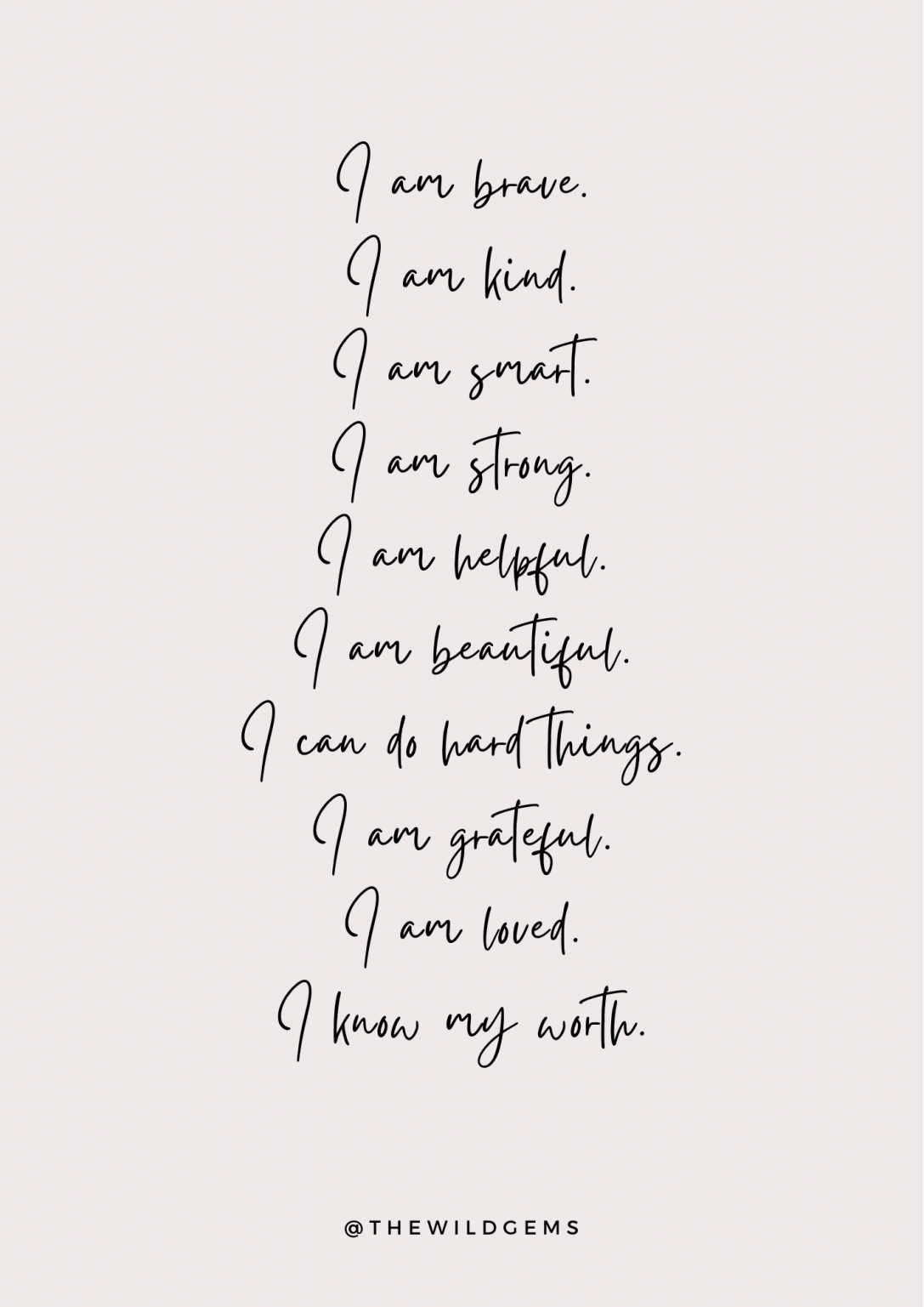
I am brave.

I am kind.

I am smart.

I am strong.

I am helpful.

I am beautiful.

I can do hard things.

I am grateful.

I am loved.

I know my worth.

If there’s an affirmation that you feel should be included leave a comment!