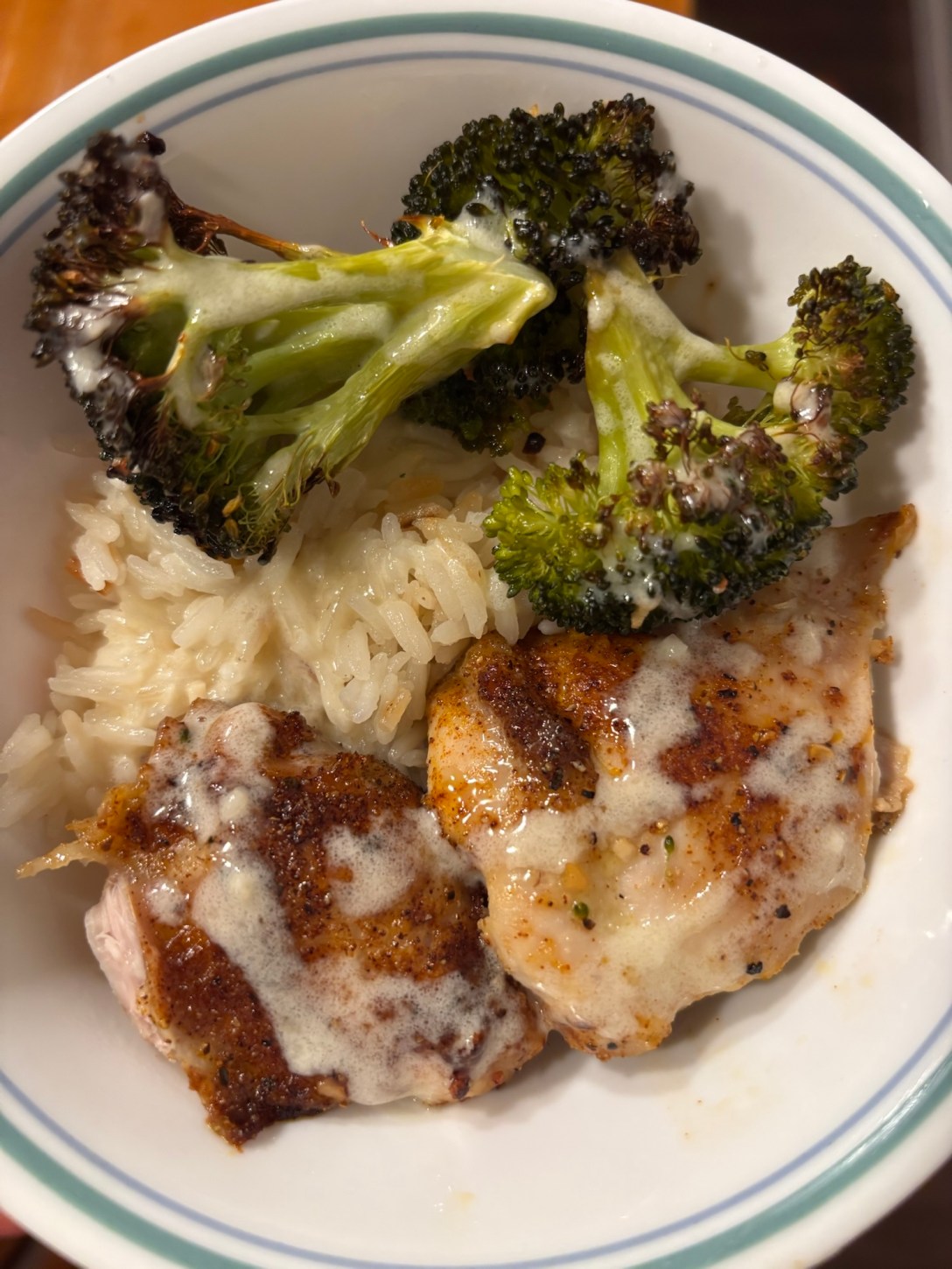
Lemon Baked Butter Chicken

Ingredients

For the chicken:

– 1.5–2 lbs chicken breast or thighs (cut into chunks or leave whole)

– 1 tsp salt

– 1 tsp paprika

– 1 tsp garam masala (optional but delicious)

– 1 tsp garlic powder

– ½ tsp onion powder

– ¼ tsp black pepper

For the sauce:

– 4 tbsp butter

– 3–4 garlic cloves, minced (or 1 tsp garlic powder)

– 1 cup heavy cream

– 1 tsp honey

– 1 tsp curry powder or garam masala ½ tsp turmeric (optional for color)

– ½ tsp salt (taste and adjust)

Optional: ¼ cup chicken broth to thin it out

1 tbsp lemon juice


Serves well with roasted broccoli and rice.

Enjoy!

Soften The Heart #33 : Children Are a Gift — Even When Our Childhood Didn’t Feel Like One

“Children are a gift from the Lord; they are a reward from Him.”

Psalm 127:3

Children are one of the clearest pictures of God’s heart. Their curiosity, honesty, wonder, and purity remind us of what truly matters. Scripture tells us that children are a gift — not because of what they do, but because of who they are: reflections of God’s creativity and love.

As parents, this verse reminds us to slow down and cherish our kids, to remember that they’re not burdens or interruptions but blessings entrusted to us. They bring joy, purpose, and a fresh view of the world.

But for many adults, this verse can stir something deeper.

Not everyone grew up feeling protected, valued, or cherished. Some people carry wounds from a childhood where they were mistreated, overlooked, or harmed. And hearing “children are a gift” can feel confusing — even painful.

So if that’s you, here’s something important to know:

**God’s intention for children was always good.

Your pain was never His plan.**

When the Bible calls children a gift, it is describing how God sees them — not how every human treats them. Some adults act out of their own brokenness, and their choices leave deep marks on innocent hearts. But your mistreatment was never a reflection of your worth. You were always precious. You were always a gift. Someone else simply failed to honor what God created.

And God grieves with you.

He is “close to the brokenhearted” (Psalm 34:18) and fiercely protective of the vulnerable. Jesus Himself said it would be better for a person to be thrown into the sea than to harm a child (Matthew 18:6). That means He saw you. He cared. He never agreed with what was done to you.

The good news?

God restores what was wounded.

He heals the childhood parts of us that were hurt, silenced, or forgotten. And He gently rebuilds what was broken — identity, trust, safety, and hope.

So whether you grew up cherished or neglected, this verse has a message for you:

Cherish the children in your life today — including the child you once were.

Let today be a reminder to love your kids with intention and tenderness…

but also to let God love and restore the parts of you that didn’t receive that same tenderness growing up.

Children are a gift.

And that includes you — the child you used to be, and the person you are becoming.

Understanding Your Luteal Phase: The Inner Autumn of Your Cycle And How To Honor This Season

Your inner Autumn is the luteal phase of your cycle — the days after ovulation and before your period (one or two weeks before you begin).

Just like the season, it’s a time of slowing down, turning inward, and releasing what you no longer need. You may feel more sensitive, reflective, or craving rest. It’s your body’s way of preparing for renewal.

What’s Happening in Your Body

After you ovulate, your body begins to produce more progesterone, a hormone that helps prepare your uterus for a possible pregnancy. If no fertilized egg implants, hormone levels eventually drop, signaling your body that it’s time to shed the uterine lining — which becomes your period.

This phase usually lasts around 10–14 days. (as mentioned one to two before your period. Side note: every woman’s body is different. Some may last longer or shorter.)

How You Might Feel

As hormones shift, it’s normal to notice changes both physically and emotionally. Some common experiences during the luteal phase include:

•Feeling more tired or sensitive

• Bloating or breast tenderness

• A stronger need for rest and reflection

• Cravings for comfort foods

• Desire for alone time or quiet

• Moody/Irritable

• The need to clean or organize

You may also notice that while your energy is lower, your intuition and emotional awareness become stronger. This is a beautiful time to reflect, tidy up loose ends, and nurture yourself.


How To Honor Your ‘Inner Autumn’ As A Woman – Luteal Phase

1. Slow the pace

Say gentle “no’s” to things that drain you. Schedule fewer social plans and more cozy, restorative time. Allow yourself to rest without guilt — this is nature’s built-in reset.

2. Nourish your body

Eat warm, grounding foods: roasted vegetables, soups, oats, root veggies, and herbal teas (especially cinnamon, ginger, and chamomile). Focus on complex carbs and magnesium-rich foods (like bananas, dark chocolate, nuts, and leafy greens) to ease PMS and support calm. Stay hydrated, especially if you tend to bloat or get constipated.

3. Nurture your emotions

Journal what’s coming up — your luteal phase often reveals what’s not aligned in your life. Be gentle with yourself; your sensitivity is heightened for a reason. Create small rituals of comfort (warm bath, candlelight, quiet evenings).

4. Support your energy

Choose slower, grounding movement like yoga, stretching, or walking. Prioritize sleep and listen to your body’s cues to rest earlier. Practice breathwork or meditation to calm mental chatter.

5. Spiritually honor it

See this time as your “inner autumn” — a season of release, reflection, and preparation for renewal. Ask yourself: What am I ready to let go of before my new cycle begins? Light a candle or take a mindful moment each evening to thank your body for all it’s doing.

Your luteal phase is a teacher — it asks for presence, patience, and trust in your natural rhythms.

When you honor it, you often notice fewer PMS symptoms, more emotional clarity, and a deeper sense of peace with your body.
When Our Child’s Tears Mirror Our Own: Breaking the Cycle of Emotional Projection

“Until you make the unconscious conscious, it will direct your life and you will call it fate.”

Carl Jung

Why do we sometimes get triggered by our children’s emotions?

One word: Projection.

It sounds simple, but it’s layered and deeply human. Projection means we unconsciously place our own unresolved feelings onto others—often without realizing it. And with parenting, this tends to show up when our kids express emotions we weren’t allowed to feel growing up.


When Their Emotions Stir Something In Us

Let’s say your child starts crying over something that seems small—maybe they can’t get their shoes on. You feel irritation rise. You say, “You’re fine. Stop crying. It’s not a big deal.”

But under that reaction might be this:

You weren’t allowed to cry when you were small. You were told to toughen up. Crying meant weakness. And now, when your child does what you weren’t permitted to do, it brings up old pain you never had space to process.

What you’re feeling isn’t just about their emotion—it’s about your history with that emotion.

How Do We Break the Cycle?

1. Pause Before Reacting

Even a brief pause creates space. In that moment, silently ask yourself:

“What am I feeling right now?” “Is this about them… or something unresolved in me?”

This small habit can change everything.

2. Get Curious Instead of Controlling

Shift from, “This needs to stop,” to, “What are they trying to express?”

Emotions are messages. Our children are not giving us a hard time—they’re having a hard time.

3. Reflect on Your Own Story

Later, when things are quiet, explore:

“Was I allowed to feel this as a child?” “What did I learn about emotions like anger or sadness?”

Self-awareness is the first door to healing.

4. Reparent Yourself as You Parent Your Child

When your child is upset, respond with:

To them: “It’s okay to feel that way. I’m here.” To yourself: “I wasn’t taught this, but I’m learning now. We’re both safe.”

You’re not just raising a child—you’re healing generations.

5. Offer Yourself Compassion

Getting triggered doesn’t mean you’re failing. It means there’s something inside you that’s asking to be felt, seen, and gently loved. The more grace you give yourself, the more you’ll have to give.

This work isn’t easy. But every time you choose to pause, to stay present, and to feel instead of react, you are breaking a cycle—and building a new legacy.

One where emotion is not feared, but welcomed.

One where your child feels safe to be fully themselves.

And one where you get to heal in the process.

Protect Their Light: A Call to Kindness for Children

Not even children get a free pass when it comes to “life.” There are so many children out there who have had to grow up far too soon, and it’s truly heartbreaking.

Too often, we overlook children and assume they don’t have life experience, but believe me when I tell you there are children who have been through more than many adults.

Life is not fair, this we know. But it’s especially unfair to children. They deserve so much more than what life often hands them.

Never look down on them. Be there for them. Help them navigate their pain. Not all children have the right words yet for what they feel. Sometimes they don’t need your advice, they just need you to listen. Offer your hand of guidance. Let them know they are not alone.

There is so much we can learn from children. They have a unique way of seeing the world, and their resilience is nothing short of remarkable. And though life is what it is, we have to try to protect them. We have to try to preserve their innocence as long as we can.

Children deserve the chance to stay children. They deserve to dream, to feel safe, and to be surrounded by love. When we protect their light, we allow them to shine in ways that make this world a better place.

When we show them love and understanding, we’re not only shaping their future but also shaping a kinder world for all of us.

Behind Courage Is Fear

Everyone has fears. They act as roadblocks, and you can either let them stop you or find another way forward. Fear is natural—it’s a part of being human—but it doesn’t have to control you. Instead, embrace it as an open door leading to new journeys and opportunities. Bravery is born through fear. Be brave.

The power lies in your perspective.

There’s a poem by Erin Hanson:

There is freedom waiting for you,

On the breezes of the sky,

And you ask, ‘What if I fall?’

Oh but my darling,

What if you fly?”

At first glance, it’s a simple poem you might have heard before, but sometimes the meaning doesn’t fully sink in until the right moment. These words remind us that fear often speaks louder than possibility, yet it’s possibility that holds the key to our growth.

Let’s say you want to try something new. Before you even begin, you’re already anticipating the worst. “What if it’s a waste of time? What if I fail?” That mindset keeps you frozen in place, holding you back from something that could change your life. But what if it isn’t? What if you take the leap and find yourself soaring? You’ll never know unless you try.

Not long ago, I was talking to my mom, and I asked her, “Mom, how are you so brave?” Motherhood scared me at the time—the responsibility, the unknown, the fear of not being enough. Her response surprised me. She laughed and said, “That’s the same question I asked my mom.” It reminded me that courage doesn’t mean the absence of fear. It means moving forward despite it.

The truth is, we’re all afraid sometimes, but we each have the power to strengthen our courage muscle. And we can’t give up on it because bravery isn’t just about us—it’s about the light we create for others. I believe that when we choose courage, everything around us begins to glow in a way. We become a light in someone else’s darkness, and that light can make all the difference.

So the next time fear whispers, “What if I fall?”—ask yourself instead, “What if I fly?” Take the leap. Be the light. And watch how the world around you begins to glow.

Are You Angry?

“Anger is like a child—you don’t want to let them drive the car, but you also don’t want to stuff them in the trunk.”

Anger can feel overwhelming, but with the right tools, we can learn to manage it with grace:

• Breathe. Stop and take a deep breath. This creates space between you and your reaction.

• Name it. Acknowledge your feelings: “I feel angry.” “I feel tension.” Naming emotions helps diminish their intensity.

• Do it differently. Try shifting your perspective. Say, “I’m hurting. How can I be kinder to myself and those around me?”

• Inquire. Anger often carries a message. With curiosity, ask yourself, “What is my anger trying to tell me? What action do I need to take? What am I avoiding or unwilling to face?”

This practice has been a lesson for me, especially as a parent. I’ve been guilty of brushing off my children’s feelings, saying things like, “It’s not that big of a deal,” or “Why are you so upset?” But I’ve realized these moments are opportunities—to help me better understand not only my children but also myself.

Dear anger, you’re not as crazy as I thought—you’re just trying to help me see something I’ve been missing.

A Lesson From Eating Donuts

For a while, Fridays were “grocery pick-up days” in our family. And just before we’d pick up the groceries, I’d stop at a nearby donut shop and let each of my three daughters choose a donut. Usually, I’d get just enough for them, but on this “donut lesson day,” I decided to treat myself to one as well—and even got an extra for my husband.

On the drive home, my oldest finished her donut and immediately wanted more, glancing at mine hopefully. Another daughter, who had picked a new flavor, was grumbling because she didn’t like it and regretted her choice. So there we were: one daughter, longing for more, and another, frustrated with what she’d chosen.

And as I listened to them, I thought, How similar we are to children sometimes. How often do we ask for more, not even thinking about those who don’t have the luxury of choice? Or get exactly what we wanted, only to find out it’s not what we hoped? It’s like a mirror of life, where we’re constantly balancing gratitude and expectation, fulfillment and frustration. I realized teaching my children to appreciate what they have is challenging, especially when they’re so young and everything is new and full of possibility. Yet, in that moment, I saw myself in them. How many times have I behaved the same way?

And yes, I did end up sharing my donut with my daughter—because I love her. Just as we have a Creator who continues to provide for us, even when we forget to be grateful.

So maybe the donut lesson is this: life gives us chances to learn, to appreciate, and to recognize that sometimes we already have enough. Perhaps, next time we’re tempted to reach for “more,” we can pause and savor what’s already in our hands.

A Good Cry Never Hurt Anyone

Being a mother, you cry a lot. Or at least, this mother does. But you don’t have to be a parent to connect with this post—we all have those days when we’re trying our best, pushing through the challenges, reaching our breaking points, letting out a cry, dusting ourselves off, and then starting again. Life can be exhausting, and sometimes it feels like there’s no end to the cycle.

I want everyone to know that it’s OKAY to cry. Anyone who’s feeling burnt out, hurt, or frustrated…sometimes, you just need a good cry to release everything you’ve been holding inside. Each of us carries an invisible weight, and when that weight goes unrecognized, it can feel overwhelming. We all go through so much, and sometimes it feels like no one truly sees it.

Well, I SEE YOU. I know that you reading this do so much, or maybe you’ve been through a lot. I may not know all the details, but if you’re human, I know you’ve had your share of struggles. And I notice it. I want you to know that even if it feels hard, even if no one seems to understand, you’re showing up every day, and that’s incredible.

So let yourself cry if you need to—it’s a release, a reset. You’re not alone with the weight on your shoulders or the silent struggles. You’re a rockstar, and you’re stronger than you realize. Believe me.

And remember, those tears you shed are a part of the journey, softening and strengthening you all at once. They’re a sign of the love, effort, and resilience that you pour into life each day. So, let yourself feel, let yourself release, and trust that, each time you do, you’re creating space for even more strength and courage to rise within you.

Love Is A Choice – Choose To Love

Try this: whatever in your life brings up fear or anxiety, choose to love it. Anything that stirs anger? Choose love. Love isn’t just a feeling; it’s an action, and it’s a choice we have the power to make every day. The ability to love more deeply is a seed within us, and it’s one that needs nurturing.

When something frustrates or upsets you, pause, take a breath, and say, “I love you.” Don’t let stress or anger have power over you. Every person and every experience around us could use a little more love.

Instead of pushing away “it”, whatever it may be (we all have things, situations, or even people that we find challenging to love) because of the negative emotions it brings, challenge yourself to love it.

For example, imagine you just stubbed your toe on the door. (We all know how much that hurts!) Instead of cursing the door, acknowledge it with a twist: “That hurt, but I still love you, door, because you keep my family safe and give us privacy.” It may seem small, but this practice strengthens the habit of choosing love in frustrating moments. If you can learn to love something as simple as a door that caused you pain, think of how far that love can extend to the bigger challenges in life.

Some days, you’ll succeed; other days, you’ll struggle. But don’t give up, love really is the answer. I know, because I have my own struggles with this practice.

There have been moments when my children have sparked this kind of anger I didn’t even know I had, and I have to literally step back to figure out where it’s coming from.

I had to choose love.

Over time, we evolve and improve, and for that, we can be grateful for.

Love is more than a feeling, it’s a choice. Imagine a world of choose to love.